Strength & Conditioning Exercises

A group of St Finbarr’s A.C. members take part in a monthly Strength and Conditioning class at DT Fitness, Lehenaghmore Industrial Estate, Cork http://dtfitness.ie.

The trainer has kindly shared exercises for all members and has given videos demonstrating each exercise so you can try these yourself at home.

If you would like to join the Strength and Conditioning monthly classes please contact Orla Byrne, St. Finbarr’s A.C. Committee member and Women’s Captain (orlab-1@hotmail.com).

Classes take place on the first Wednesday of every Month.

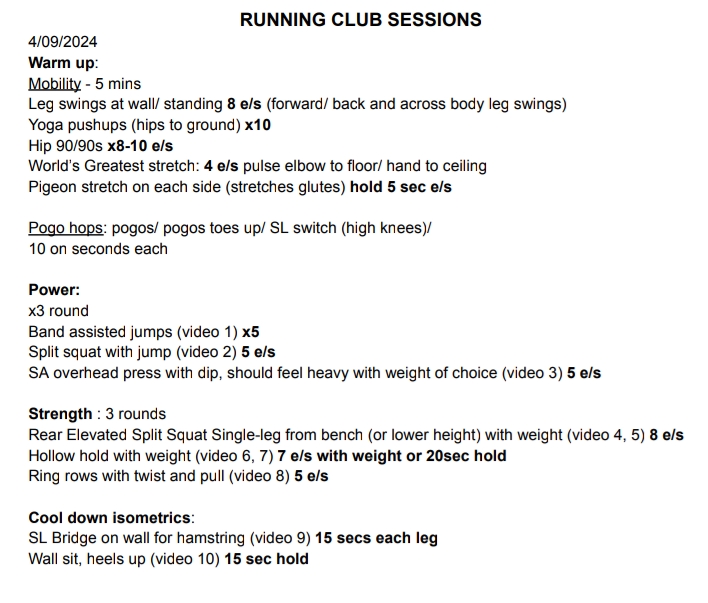
October Session 2024

  • Warm up:
  • Mobility – 5 mins
  • World’s Greatest stretch: 4 e/s elbow to floor/ hand to ceiling
  • Bird dog crunch x6-8 e/s
  • Hip 90/90s x8-10 e/s
  • Yoga pushups (hips to ground) x10
  • Pogo hops: pogos/ pogos toes up/ high knees/ heel flicks, 10 seconds on each
  • Power: 3 Rounds
  • Squat jumps holding weight jumps (video 1) x5
  • Split squat with jump, reset after each, get height on jump (video 2) 5 e/s
  • SA overhead press with dip, should feel heavy with weight of choice (video 3) 5 e/s
  • Strength: 3 Rounds
  • SL Hamstring curl with resistance back, lie on front and put ankle through band (video 4) x10
  • e/s
  • Goblet squats and hold (video 5) X5 with 5 sec hold
  • Barbell landmine rotations, thumbs at top of bar, keep arms straight (video 6) 5 e/s can adapt
  • this at home by anchoring a resistance band


Cool Down Isometrics:
SL split squat hold (video 7) 15 secs each leg
Wall sit, heels down (video 8) 15 sec hold

September Session 2024
April Session 2024:

Warm up and Mobility: Same as March Session below.

April Exercises:

Weighted Split Squat


Banded Pulls

Jammer Press


Slide Hamstring Extension


Side Plank Rotation

March Session 2024:

  • Warm up:
  • Include 10 each: pogos/ pogos toes up/ single leg hops/ single leg hops front & back / single leg hops side to side
  • Mobility – 5 mins:
  • 20/20 x 3 each
  • Jump lunges/ jump squats/ cossack squats
  • Single Leg Long lever Hamstring 3×30 seconds each side
  • Mini band standing marchers 3×10 each side
  • Bicycle crunches 3×10 each side
  • Plate step downs 3×8 each side
  • Slider rev lunges 3×5 each side

March Session Exercises:
Pogo Jump (Variation 1)

Pogo Jump (Variation 2)

Pogo Jump (Variation 3)

Plyometric Lunges

Squat Jumps

Cossack Squat

Banded Standing March

Long Lever Single Leg Bridges

Bicycle Crunches

Elevated Step Downs

Slider Lunges

Training Pace Calculator

Train too hard, and you’ll probably burn out or get injured. Train too easy and you simply won’t make the most of your potential – though hey, that’s perfectly okay too! But if you do want to try and get faster and bust out some PBs, then you do also need to know how hard to push on hard sessions – and then how easy to take it on easy runs.

Training by heart rate is one good way of getting it right. Using this calculator is another.

How to use the training pace calculator:

It’s very simple, just tap in a recent race time and press ‘calculate’.

The calculator will automatically show what sorts of speeds you should run the different components of a training week at (though don’t do them all in one week…!)

Click here for the full article: Runners World Training Pace Calculator

11 Week Half Marathon Plan

This is an 11 week half marathon training plan where the training intensity is based on Power rather than pace or heart rate. Power is measuring the effort you are putting in as you run. Running up a hill or into a headwind requires more effort – power number increases at the same speed, and of course power number decreases at the same speed as you run down a hill, so you would slow down up a hill or speed up down a hill to maintain
the same power level.


The target intensity is a percentage of what is known as your Critical Power

Power Based 11 Week Half-marathon Plan

21 Week Dublin Marathon Plan

Your training kicks off on the first week of June. But first some ground rules that are not up for negotiation.

  • If you are new to running or have not been training in recent years you must have a
    medical check-up before starting the programme.
  • Be kind to yourself: get a new pair of good training shoes. They will add to your
    enjoyment and may also prevent painful and costly injuries.
  • Do half of your training on grass.
  • Avoid running on concrete if possible.
  • Hydrate well on water – you will lose a lot of water through sweating,
    even on cool days.
  • Cut down on junk food and thereby lose weight safely. We are talking about biscuits,
    sweets, soft drinks and the like.
  • Include some races as part of your programme, preferably one every three or four weeks.
    We recommend the adidas series.
  • Take iron and vitamin C regularly. Drink less tea — it inhibits iron absorption.
  • Get plenty of rest.
    Do all the above and you should emerge on the October bank holiday Monday with a healthy, taut, beautiful body and raring to go!

    Schedules for:
  • 2:30 to 3:00 hr
  • 3:00 to 4:15 hr and
  • 4:15 to 5:00 hr

Click here for the plan: 21 Week Dublin Marathon Plan (Coach Brendan O Shea)

What is 80/20 Training?

Runners World Article by JAMES WITTS & JENNIFER BOZON UPDATED: 22 MARCH 2023.

Research tells us that running slower for the bulk of your runs really can reap huge rewards.

‘From our research, it’s clear that elite athletes (including Kipchoge) train around 80% of the time at what we’d call low intensity, and they spend just 20 per cent of their time training hard,’ says Dr Stephen Seiler of the University of Agder, Norway, one of the world’s foremost exercise physiologists.

Whether the elite is training 20 or 40 hours a week, the training broadly follows this 80/20 split,’ says Seiler.

He adds, it’s arguably more important for recreational runners because we often get our intensity all wrong when it comes to long-term fitness progress.

‘Many recreational runners feel like they must go hard every time, so they do a lot of training in this threshold area,’ says Seiler. ‘They’ll improve initially, but then they stagnate. The problem is, they become too fatigued to do high-intensity sessions.’

Studies show that recreational runners naturally gravitate towards running 50 per cent at moderate to high intensity and 50 per cent at low intensity. And when Esteve-Lanao asked experienced club runners to follow either this 50/50 split or an 80/20 split, the 80/20 group improved their 10K times by five per cent compared with 3.5 per cent for the 50/50 group.

Why should I run easy?

So what are the physiological benefits of running easy? Easy runs train the cardio and respiratory systems to work more efficiently, allowing you to run with less effort during higher-intensity runs.

Slow runs also train your slow twitch muscle fibres – which allow us to work aerobically – driving adaptations that make us better at endurance running. And so if we don’t include enough of these in our plan, we not getting enough of the appropriate aerobic stress needed for long-distance running.

Slower running also helps to strengthen the tendons, ligaments, joints and bones without causing excessive stress to them.

Both moderate- and high-intensity work cause the body too much stress to be performed in large amounts, which compromises recovery.

This doesn’t just increase your injury risk but means you go into your next high-intensity session unable to perform at your best due to fatigue, so those sessions aren’t as effective.

That’s why Kipchoge, for example, spends a lot of his time training at a low intensity – it allows him really give his hard sessions a proper go. And he only does it twice a week, in the form of one track session and the other an unstructured fartlek session. The rest of his miles are done at a very easy pace.

Sourse: Runners World