Why should you chill out on recovery runs?

A recovery run is important as it prevents injury and helps you improve your pace.

Speed workouts and long runs are the exciting part of training for a race. However, not every run can be fast or long! Slow runs have their place in training also. One of the most common mistakes runners make is running too fast all the time. As counter-intuitive as it sounds, if you want to run faster, sometimes you have to run slow – such as on recovery runs.

What are recovery runs?

Recovery runs are easy runs that you do at a very light, controlled effort. Typically, you do these runs when your legs are tired from previous training, but you want to get in more mileage for the week. Recovery runs are aerobically easy enough not to elicit any muscle damage or need for extra recovery. 

Contrary to popular misconception, recovery runs do not flush out lactic acid. Lactic acid typically clears shortly after a hard workout. However, a recovery run will pump oxygen-rich blood into damaged muscles. This is why you usually feel better after doing a recovery run! 

Since the goal of a recovery run is adding mileage without prolonging recovery, you want to cap recovery runs at approximately 60 minutes in duration. 

For the full article: www.therunkeeper.com

Everything you Need to Know About Easy Miles

Slow down!

On easy days, you’re using mostly slow-twitch muscle fibres. They have a higher density of mitochondria, high levels of aerobic enzymes and greater capillary density than fast-twitch fibres, which are more involved in higher intensity training.

Slowing down and incorporating easy miles into your training increases mitochondria and capillaries and blood flow to those muscles, so they’re better able to utilise oxygen. Without that, you can’t do the intense runs!

All runners, and especially beginners and those coming back from injury, benefit from the cardio-vascular and muscular-structural development that easy running promotes. The base fitness a runner puts down through a preponderance of easy runs enables the athlete to safely progress to other types of training.

Seasoned runners also need easy days to maintain their hard-earned aerobic fitness and to make continual gains in economy. Of course, competitive runners are interested in moving efficiently at race paces – the primary reason for training at a variety of intensities – in addition to running easy. But even slow running allows for gains in efficiency of movement.

More importantly, slow running allows you to recover properly from hard days.

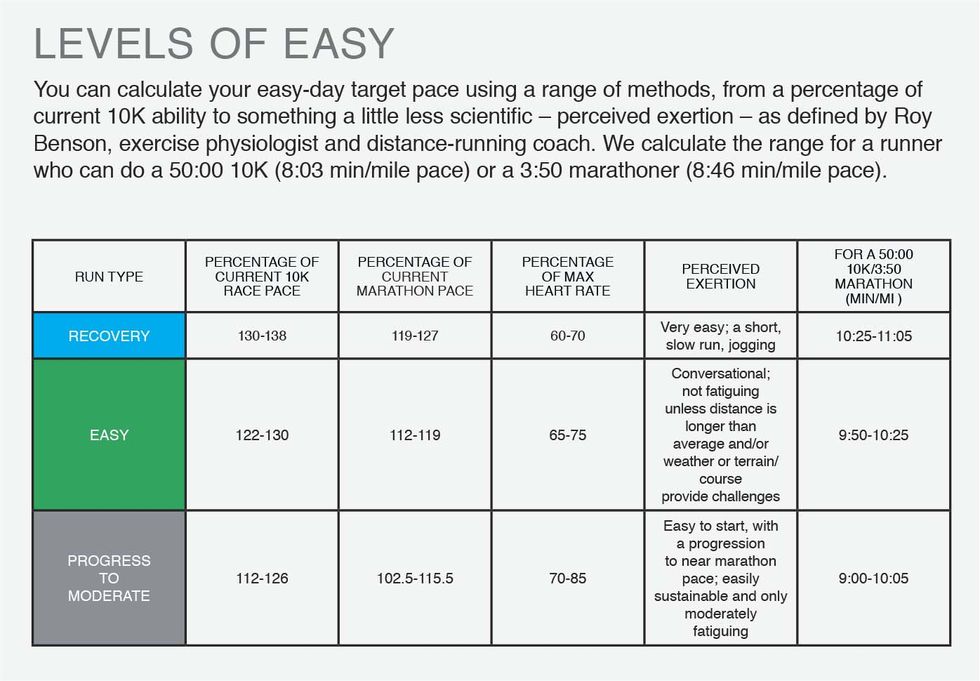
What pace should you be doing your easy runs at?

For the full article visit: https://www.runnersworld.com/uk/training/beginners/a26514237/running-pacing-easy-miles/

What is 80/20 Training?

Runners World Article by JAMES WITTS & JENNIFER BOZON UPDATED: 22 MARCH 2023.

Research tells us that running slower for the bulk of your runs really can reap huge rewards.

‘From our research, it’s clear that elite athletes (including Kipchoge) train around 80% of the time at what we’d call low intensity, and they spend just 20 per cent of their time training hard,’ says Dr Stephen Seiler of the University of Agder, Norway, one of the world’s foremost exercise physiologists.

Whether the elite is training 20 or 40 hours a week, the training broadly follows this 80/20 split,’ says Seiler.

He adds, it’s arguably more important for recreational runners because we often get our intensity all wrong when it comes to long-term fitness progress.

‘Many recreational runners feel like they must go hard every time, so they do a lot of training in this threshold area,’ says Seiler. ‘They’ll improve initially, but then they stagnate. The problem is, they become too fatigued to do high-intensity sessions.’

Studies show that recreational runners naturally gravitate towards running 50 per cent at moderate to high intensity and 50 per cent at low intensity. And when Esteve-Lanao asked experienced club runners to follow either this 50/50 split or an 80/20 split, the 80/20 group improved their 10K times by five per cent compared with 3.5 per cent for the 50/50 group.

Why should I run easy?

So what are the physiological benefits of running easy? Easy runs train the cardio and respiratory systems to work more efficiently, allowing you to run with less effort during higher-intensity runs.

Slow runs also train your slow twitch muscle fibres – which allow us to work aerobically – driving adaptations that make us better at endurance running. And so if we don’t include enough of these in our plan, we not getting enough of the appropriate aerobic stress needed for long-distance running.

Slower running also helps to strengthen the tendons, ligaments, joints and bones without causing excessive stress to them.

Both moderate- and high-intensity work cause the body too much stress to be performed in large amounts, which compromises recovery.

This doesn’t just increase your injury risk but means you go into your next high-intensity session unable to perform at your best due to fatigue, so those sessions aren’t as effective.

That’s why Kipchoge, for example, spends a lot of his time training at a low intensity – it allows him really give his hard sessions a proper go. And he only does it twice a week, in the form of one track session and the other an unstructured fartlek session. The rest of his miles are done at a very easy pace.

Sourse: Runners World