Follow the links for presentation PDFS on the following topics:
The Role of Sports Psychology in Performance
Endurance Athlete Strength and Conditioning

Follow the links for presentation PDFS on the following topics:
The Role of Sports Psychology in Performance
Endurance Athlete Strength and Conditioning
Slow down!
On easy days, you’re using mostly slow-twitch muscle fibres. They have a higher density of mitochondria, high levels of aerobic enzymes and greater capillary density than fast-twitch fibres, which are more involved in higher intensity training.
Slowing down and incorporating easy miles into your training increases mitochondria and capillaries and blood flow to those muscles, so they’re better able to utilise oxygen. Without that, you can’t do the intense runs!
All runners, and especially beginners and those coming back from injury, benefit from the cardio-vascular and muscular-structural development that easy running promotes. The base fitness a runner puts down through a preponderance of easy runs enables the athlete to safely progress to other types of training.
Seasoned runners also need easy days to maintain their hard-earned aerobic fitness and to make continual gains in economy. Of course, competitive runners are interested in moving efficiently at race paces – the primary reason for training at a variety of intensities – in addition to running easy. But even slow running allows for gains in efficiency of movement.
More importantly, slow running allows you to recover properly from hard days.
What pace should you be doing your easy runs at?
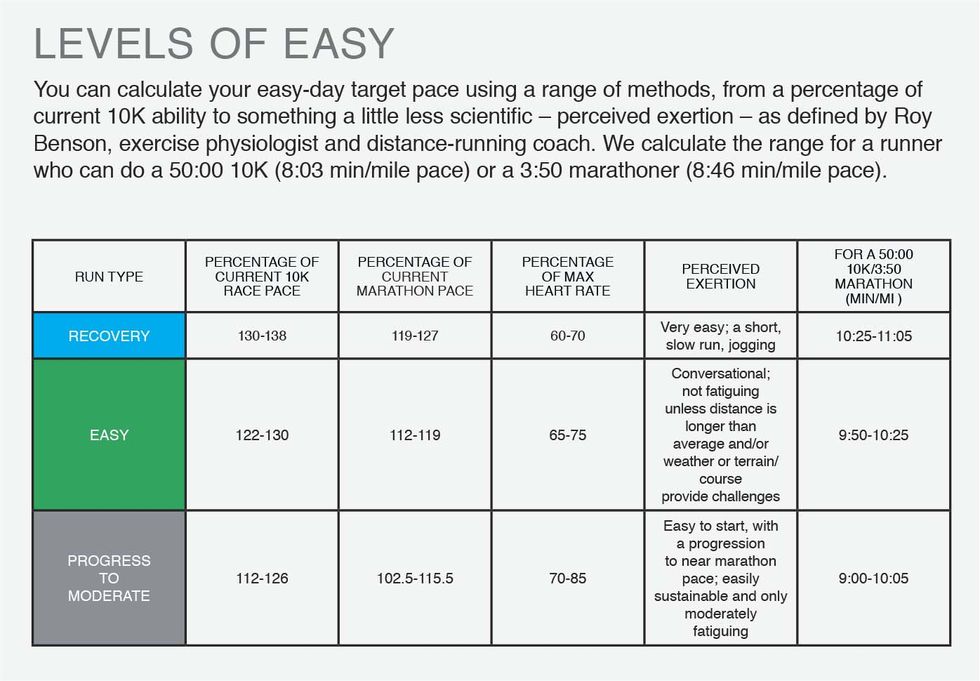

For the full article visit: https://www.runnersworld.com/uk/training/beginners/a26514237/running-pacing-easy-miles/
Improve speed or distance
The goal of the tempo run is to push your body to run harder and faster for longer periods of time, says Molly Armesto, a running coach and founder of All About Marathon Training.
To do this, you need to increase your anaerobic threshold, which helps your body adapt to running at a faster pace while not fatiguing as easily.
Improve Cardio
Tempo runs are a great way to increase your aerobic fitness over long periods of time and preserve the fitness you’ve gained from other workouts.
Tempo runs are also a great way to build mental toughness since many of these workouts are done at a pace that could be more difficult than you’re used to.
Click for the full article: https://www.healthline.com/health/tempo-run
For experienced runners, many turn to a fartlek run as a new challenge that breaks up their normal routine. Fartlek sessions are a challenging workout that pushes runners outside their comfort zone and combines a mix of warm-up pace, speed work, sprinting, and cool-downs into a constant interval training session designed to increase your heart rate.
A fartlek run is defined as “continuous training with interval training.” The word “fartlek” is Swedish for “speed play,” highlighting its focus on a medley of fast and slow bursts of running during the duration of the workout.
So, are we introducing fartleks into our training plans just because it’s a cool name? Well, if it sounds strikingly close to interval training and tempo runs, you’re not wrong. A fartlek is a type of interval run that incorporates tempo. However, there are still key differences between the three:

For the full article visit: https://therunexperience.com/fartlek/
This type of structured training builds speed and offers new challenges for both beginner and experienced runners. Here’s how to do it right.
Picking up your pace through interval training has countless advantages for your overall performance, on and off the track. This type of work helps you gain a more efficient stride and improve your VO2 max, says Nell Rojas, USATF-certified run coach and certified personal trainer in Boulder, CO, and Honey Stinger-sponsored athlete. Science backs this up, saying intervals can improve power, reduce time to exhaustion, better your VO2max and boost heart health.
From a mental stimulation standpoint, you have to challenge your mind to focus on a specific pace,” rather than zoning out and just checking off miles as you might do on long-distance, relaxed-paced runs.
Plus, intervals build the aerobic capacity needed to do those longer runs, which is important for all runners but especially those new to the sport. Someone who hasn’t run much, for example, might find the idea of running 30 to 40 minutes non-stop an intimidating feat. But five or 10 minutes with walk breaks? That’s doable. Confidence building is a big benefit.
To top it off, because you’re accelerating and decelerating, you strengthen your mechanics and become a more well-rounded runner. “Running intervals allows for an increase in intensity and creates a contrast between the work interval and recovery period—this contrast can really awaken muscles that often get a little ‘sleepy’ from constant steady pace mileage.
Source:https://www.runnersworld.com/training/a33384987/how-to-progress-your-interval-training/
This is an 11 week half marathon training plan where the training intensity is based on Power rather than pace or heart rate. Power is measuring the effort you are putting in as you run. Running up a hill or into a headwind requires more effort – power number increases at the same speed, and of course power number decreases at the same speed as you run down a hill, so you would slow down up a hill or speed up down a hill to maintain
the same power level.
The target intensity is a percentage of what is known as your Critical Power
Your training kicks off on the first week of June. But first some ground rules that are not up for negotiation.
Click here for the plan: 21 Week Dublin Marathon Plan (Coach Brendan O Shea)
Runners World Article by JAMES WITTS & JENNIFER BOZON UPDATED: 22 MARCH 2023.
Research tells us that running slower for the bulk of your runs really can reap huge rewards.
‘From our research, it’s clear that elite athletes (including Kipchoge) train around 80% of the time at what we’d call low intensity, and they spend just 20 per cent of their time training hard,’ says Dr Stephen Seiler of the University of Agder, Norway, one of the world’s foremost exercise physiologists.
Whether the elite is training 20 or 40 hours a week, the training broadly follows this 80/20 split,’ says Seiler.
He adds, it’s arguably more important for recreational runners because we often get our intensity all wrong when it comes to long-term fitness progress.
‘Many recreational runners feel like they must go hard every time, so they do a lot of training in this threshold area,’ says Seiler. ‘They’ll improve initially, but then they stagnate. The problem is, they become too fatigued to do high-intensity sessions.’
Studies show that recreational runners naturally gravitate towards running 50 per cent at moderate to high intensity and 50 per cent at low intensity. And when Esteve-Lanao asked experienced club runners to follow either this 50/50 split or an 80/20 split, the 80/20 group improved their 10K times by five per cent compared with 3.5 per cent for the 50/50 group.
So what are the physiological benefits of running easy? Easy runs train the cardio and respiratory systems to work more efficiently, allowing you to run with less effort during higher-intensity runs.
Slow runs also train your slow twitch muscle fibres – which allow us to work aerobically – driving adaptations that make us better at endurance running. And so if we don’t include enough of these in our plan, we not getting enough of the appropriate aerobic stress needed for long-distance running.
Slower running also helps to strengthen the tendons, ligaments, joints and bones without causing excessive stress to them.
Both moderate- and high-intensity work cause the body too much stress to be performed in large amounts, which compromises recovery.
This doesn’t just increase your injury risk but means you go into your next high-intensity session unable to perform at your best due to fatigue, so those sessions aren’t as effective.
That’s why Kipchoge, for example, spends a lot of his time training at a low intensity – it allows him really give his hard sessions a proper go. And he only does it twice a week, in the form of one track session and the other an unstructured fartlek session. The rest of his miles are done at a very easy pace.
Sourse: Runners World
The year is drawing to a close and we need to raise the issue of registration for 2024. In previous years, AAI insurance for registered athletes was extended to the end of January of the following year. This year, the Athletics Ireland system for 2024 has been up and running since November 20th. Consequently, all athletes insurance will expire on December 31st.
Athletes will NOT be covered for training or able to enter any competitions in 2024 if they have not registered for 2024. Sadly, that little end of January perk has gone by the wayside and we must now request our members to pre-register for 2024 as quickly as possible.
The annual subscription for 2024 is 70 euro.
Click here for Payment Options and 2024 Membership Form
If you use Bank Transfer, please state your FULL NAME first and foremost. Narratives like Club Sub, BARRS Payment, Track Fees, , etc. will result in unknown payments. We would encourage existing members not to use Standing Orders and have removed this option from the membership form.
AAI registration requires an Emergency Contact Name and Number for each club member. This is really a no brainer! If you have an Emergency at training or competition, we or the AAI need to know who to contact. We currently have ICE (in case of emergency) details for about 50% of the club and need to close out the list the other 50%. So, please comply with any request from us for ICE details.
In the meantime, we wish all our members and friends a very happy Christmas and all the best (of running) for the new year.
Club Registrar,
St. Finbarr’s A.C.