Why Every Runner Should Do Speed Work

Speed workouts are a staple in many training plans – and for a good reason. Whether you are training for a fast 5K or want to complete a marathon, speed work is essential for becoming a faster and stronger runner. 

Speed work refers to a type of running workout in which you are running for certain intervals near, at, or even faster than your VO2max pace. Your VO2max is a measure of how much oxygen your body can use; most runners will hit their VO2max pace around their 5K to 3K (2-mile) pace, although you do get benefits doing it slightly slower.

During speed workouts, you maximally activate your slow-twitch muscles and intermediate muscle fibers, which increases your aerobic capacity.

Speed workouts also increase your production of myoglobin, which is a protein found in your muscles. Myoglobin transports oxygen to the mitochondria in your muscles, which in turn produce ATP to give your muscles energy. So, as you increase your myoglobin, you improve your body’s ability to quickly transport oxygen to the muscles for energy, making you able to run faster. Speed work is uniquely beneficial in this aspect, as research indicates that high-intensity running is the best way to develop myoglobin.

While you may not significantly increase your VO2max (genetics can limit it), you will see clear benefits of speedwork. Your body will become more efficient at recruiting your fast-twitch muscles. Your running economy will improve, so that you expend less energy and can run faster at the same effort level, whether you are running a 5K or 50K.

Click here for full article: https://runkeeper.com/cms/training/why-every-runner-should-do-speed-work/

Meet the Women’s Captain – Orla Byrne

10 Questions for Orla Byrne, St. Finbarr’s A.C. Women’s Captain.

  1. Where are you from?

    I am originally from Clonmel but Cork is now home. I was also born in Cork!
  2. How long are you a club member?

    I joined the club in 2019 after returning from working abroad.
  3. What was it that attracted you to join St Finbarr’s AC?

    I was looking for the chance to improve my running in a social setting where there wouldn’t be too much pressure to compete. St. Finbarr’s was the perfect choice!
  4. What is the best part of being a club member?

    Honestly the craic and welcoming atmosphere on the track and at training is brilliant. Having the chats and getting to know people from all walks of life is a special part of being in the club. It’s also a great way to learn more about the running scene and improve your knowledge of training.
  5. Who is your athletics idol/hero?

    Marion Lyons, one of our coaches and club vice president, has to be mentioned here. She really has paved the way for female runners from Cork. In 1978, she was among the first women to compete with men in the Cork to Cobh 15 mile race! I am also blown away by Fionnuala McCormick who qualified for her 5th Olympics this year 5 months after giving birth. 🤯
  6. What is your favourite athletics event?

    I really enjoy the combination of speed, endurance and mental strength that comes with competing in road distances of anywhere between 5k and half marathons (I should probably focus more on one!)
  7. Track, Trail, Cross Country or Road?

    However, there is something about XC that can’t be compared to other events. It is tough, testing and possibly the purest form of racing but the buzz of being part of a team and giving it your all is worth it!
  8. What single achievement are you most proud of as Club Captain in 2023?

    2023 was an exciting year as captain seeing the club grow and our women competing across a range of events. From roads to track to mountains to muddy fields, there has been podium finishes, team medals and PBs🎉 The XC season was very successful for our ladies teams at county level and we’ve had many new members get involved.
  9. What are your goals as ladies club captain for 2024

    I think continuing supporting our ladies across different events but also to get more people involved in championship racing and team events where you get the opportunity to experience the quality Irish running scene. Aiming to get teams out in Munster and national events would be fantastic but also encouraging newcomers to try out competing and experiencing races in a friendly supportive environment is important.
  10. Who is your “one to watch” for 2024?

    That is a tough one! There are so many amazing women on top form right now. Currently in the club Anita Locke is dominating the IMRA races and Rebecca McEvoy should have a great racing season ahead. I think Louisa Browne is showing huge potential,l as is Jennifer Martin with great times in the last few months.

Thanks Orla, and best of luck as Ladies Captain for 2024.

Interviewer Club PRO Cian McParland

Member Spotlight – Share Your Story

    Upload Your Photo:

    Everything you Need to Know About Easy Miles

    Slow down!

    On easy days, you’re using mostly slow-twitch muscle fibres. They have a higher density of mitochondria, high levels of aerobic enzymes and greater capillary density than fast-twitch fibres, which are more involved in higher intensity training.

    Slowing down and incorporating easy miles into your training increases mitochondria and capillaries and blood flow to those muscles, so they’re better able to utilise oxygen. Without that, you can’t do the intense runs!

    All runners, and especially beginners and those coming back from injury, benefit from the cardio-vascular and muscular-structural development that easy running promotes. The base fitness a runner puts down through a preponderance of easy runs enables the athlete to safely progress to other types of training.

    Seasoned runners also need easy days to maintain their hard-earned aerobic fitness and to make continual gains in economy. Of course, competitive runners are interested in moving efficiently at race paces – the primary reason for training at a variety of intensities – in addition to running easy. But even slow running allows for gains in efficiency of movement.

    More importantly, slow running allows you to recover properly from hard days.

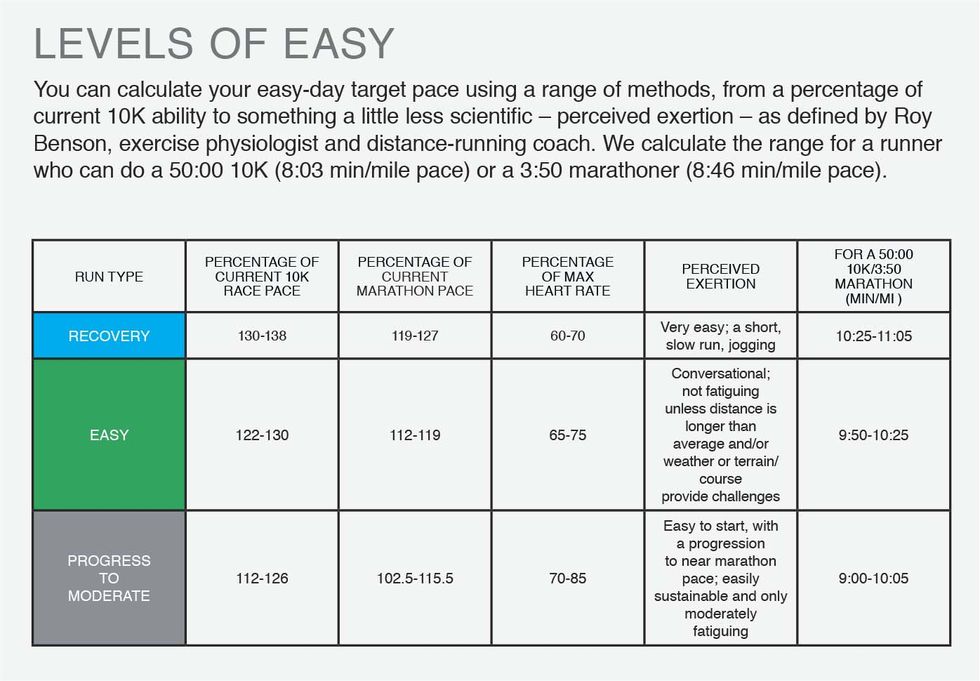
    What pace should you be doing your easy runs at?

    For the full article visit: https://www.runnersworld.com/uk/training/beginners/a26514237/running-pacing-easy-miles/

    How to Get in That Tempo Run

    Improve speed or distance

    The goal of the tempo run is to push your body to run harder and faster for longer periods of time, says Molly Armesto, a running coach and founder of All About Marathon Training.

    To do this, you need to increase your anaerobic threshold, which helps your body adapt to running at a faster pace while not fatiguing as easily.

    Improve Cardio

    Tempo runs are a great way to increase your aerobic fitness over long periods of time and preserve the fitness you’ve gained from other workouts.

    Improve mental endurance

    Tempo runs are also a great way to build mental toughness since many of these workouts are done at a pace that could be more difficult than you’re used to.

    Tempo run pace

    4 ways to get your tempo pace

    • at a point where it’s harder to hold a conversation with someone
    • 80 to 90 percent of your VO₂ max
    • 85 to 90 percent of your max heart rate
    • a pace between your half marathon and 10K race speed

    Click for the full article: https://www.healthline.com/health/tempo-run

    Fartlek Training: What Is It, Benefits, Tips, and Workouts

    Fartlek Training: The Complete Overview

    For experienced runners, many turn to a fartlek run as a new challenge that breaks up their normal routine. Fartlek sessions are a challenging workout that pushes runners outside their comfort zone and combines a mix of warm-up pace, speed work, sprinting, and cool-downs into a constant interval training session designed to increase your heart rate.

    What Is a Fartlek Training Run?

    fartlek run is defined as “continuous training with interval training.” The word “fartlek” is Swedish for “speed play,” highlighting its focus on a medley of fast and slow bursts of running during the duration of the workout.

    Fartlek Runs vs. Tempo Runs vs. Interval Runs: What’s the Difference?

    So, are we introducing fartleks into our training plans just because it’s a cool name? Well, if it sounds strikingly close to interval training and tempo runs, you’re not wrong. A fartlek is a type of interval run that incorporates tempo. However, there are still key differences between the three:

    For the full article visit: https://therunexperience.com/fartlek/

    How to Safely and Effectively Progress Your Interval Training

    This type of structured training builds speed and offers new challenges for both beginner and experienced runners. Here’s how to do it right.

    Picking up your pace through interval training has countless advantages for your overall performance, on and off the track. This type of work helps you gain a more efficient stride and improve your VO2 max, says Nell Rojas, USATF-certified run coach and certified personal trainer in Boulder, CO, and Honey Stinger-sponsored athlete. Science backs this up, saying intervals can improve power, reduce time to exhaustion, better your VO2max and boost heart health.

    From a mental stimulation standpoint, you have to challenge your mind to focus on a specific pace,” rather than zoning out and just checking off miles as you might do on long-distance, relaxed-paced runs.

    Plus, intervals build the aerobic capacity needed to do those longer runs, which is important for all runners but especially those new to the sport. Someone who hasn’t run much, for example, might find the idea of running 30 to 40 minutes non-stop an intimidating feat. But five or 10 minutes with walk breaks? That’s doable. Confidence building is a big benefit.

    To top it off, because you’re accelerating and decelerating, you strengthen your mechanics and become a more well-rounded runner. “Running intervals allows for an increase in intensity and creates a contrast between the work interval and recovery period—this contrast can really awaken muscles that often get a little ‘sleepy’ from constant steady pace mileage.

    Source:https://www.runnersworld.com/training/a33384987/how-to-progress-your-interval-training/

    11 Week Half Marathon Plan

    This is an 11 week half marathon training plan where the training intensity is based on Power rather than pace or heart rate. Power is measuring the effort you are putting in as you run. Running up a hill or into a headwind requires more effort – power number increases at the same speed, and of course power number decreases at the same speed as you run down a hill, so you would slow down up a hill or speed up down a hill to maintain
    the same power level.


    The target intensity is a percentage of what is known as your Critical Power

    Power Based 11 Week Half-marathon Plan

    21 Week Dublin Marathon Plan

    Your training kicks off on the first week of June. But first some ground rules that are not up for negotiation.

    • If you are new to running or have not been training in recent years you must have a
      medical check-up before starting the programme.
    • Be kind to yourself: get a new pair of good training shoes. They will add to your
      enjoyment and may also prevent painful and costly injuries.
    • Do half of your training on grass.
    • Avoid running on concrete if possible.
    • Hydrate well on water – you will lose a lot of water through sweating,
      even on cool days.
    • Cut down on junk food and thereby lose weight safely. We are talking about biscuits,
      sweets, soft drinks and the like.
    • Include some races as part of your programme, preferably one every three or four weeks.
      We recommend the adidas series.
    • Take iron and vitamin C regularly. Drink less tea — it inhibits iron absorption.
    • Get plenty of rest.
      Do all the above and you should emerge on the October bank holiday Monday with a healthy, taut, beautiful body and raring to go!

      Schedules for:
    • 2:30 to 3:00 hr
    • 3:00 to 4:15 hr and
    • 4:15 to 5:00 hr

    Click here for the plan: 21 Week Dublin Marathon Plan (Coach Brendan O Shea)